Christopher Merrill

  Home | Works | Bio  


Works

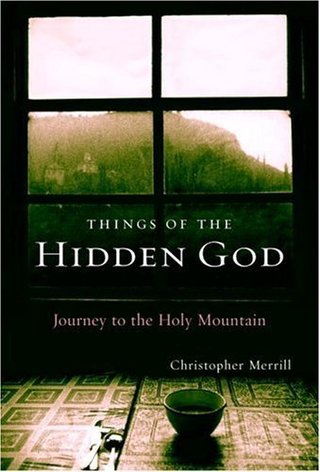
Things of the Hidden God
Journey to the Holy Mountain

If you were a poet returning from war-ravaged Yugoslavia with a marriage on the rocks and credit-card companies after you, where would you go to get away from it all? Christopher Merrill’s choice, several times between 1998 and the millennium’s eve, was Mount Athos. The only women to have entered this thousand-year-old monastic republic in northern Greece — a watchtower for Byzantium, he calls it — have been halted by guards as they stepped from the boat or warned off by the voice of the Virgin Mary.
Some of Merrill’s experiences on Athos are equally forbidding. He arrives at the Serbian monastery, to be asked ‘You like racquet ball?’ and, nodding politely, is told the world championship results: ‘Yugoslavia just won...Russia second, USA third.’ He decides to move on.

The author of this impressive account of a place hard to tie down is not often daunted, even in the face of violence. When treated to a one-sided lecture on Serbian sufferings, he speaks of what he knows, with powerful and peaceable self-restraint. Although — perhaps because — he once spent an afternoon pinned down by sniper fire, he knows when to walk away from a conversation that is not going anywhere.

Athos, then, spoke to him in the depths of war. Arriving on its shores to navigate his crises through an ancient faith, he keeps an eye open for humour. In church between a wide-eyed Alyosha Karamazov figure and a sleeping bishop, he hears a monk remark, ‘Better to sleep inside the ark of the church than outside.’ Whether people are sneering at him, taking food away from him because he is not Orthodox, or sharing a moment of spiritual connection, Merrill writes everything down. So persistent is he that in a Montenegrin monastery, before he ever went to Athos, a monk grabbed his pen, and told him to take his racist slurs to heart, not just down on paper.

Many scenes here spice up the spiritual landscape, and much of what makes the Holy Mountain surprisingly approachable — if you are the right sex — comes alive. Like most Athonite writers Merrill quotes Gregory of Nyssa on the Constantino- politans arguing about the Trinity rather than the price of bread. He has no need of historical crutches, though: his ear for dialogue in his own day is up to passing on some delightful moments.

But Journey to the Holy Mountain is more than a series of good anecdotes. The pressures on the author’s marriage provide an intensely felt frame that draws us into his world. The story, refreshing for a book on Athos, is as much about the women in his life, whether his wife or daughters — or others he fantasises about as he treads the lonely ways of the desert, beset by thoughts of wolves.

It is, appropriately, a spiritual book. Merrill finds an attractive notion in Orthodoxy that theology and the mystical are not separate branches of a larger tree. They must be the same, otherwise religious people are wasting their time. He speaks beautifully about the mystical in worldly life. Relationships, for instance, are like icons: ‘We see through each other to the divine spark at the core of our separate selves.’

He is good, too, on spiritual and poetic awakenings, linking his personal experience to other poets, and writes as deeply about this as he does alertly about that to which he is a stranger. The combination is a successful one, and typically Athos draws it out. Whatever you have in mind as you sail there, the rocky paths will bring alive in a powerful way.

For Merrill, torn by worldly concerns and the suffering he has witnessed, awareness of others — compassion, essentially — enables him to get to the heart of a tradition that, he tells us, is far from his own. His contrasting of an image from Elizabeth Bishop with monastic life is as close to a perfect description of what that life is not about as I have seen.

When he departs Athos’s shores, it is an emotional leavetaking. Whether it is the Russian monk, sitting beside him silently in a cave, saying just two words to him rich in fellow-feeling — ‘prayer’ and ‘God’ — or ‘the dynamics of faith’ reverberating in ‘every part’ of his being, you sense that, whether he returns or not, Athos has given him something, as he honestly tells us, on which to rebuild his life. Does he get his family back? Well, you don’t need to travel there, monastic passports and all, to find out.
--Matthew Spencer
The Spectator, April 24, 2004

Only the Nails Remain:
Scenes from the Balkan Wars

A chronicle of the writer’s ten war-time journeys to the Balkans. At once a travelogue, a book of war reportage, and a biography of the imagination under siege, this book provides a portrait of the poetry, the politics, and the people of the Balkans.

Brilliant Water
“Christopher Merrill has always been a poet of the outdoors. Like the hikes of the Romantics, his vigorous jaunts into the pastoral landscape catalyze intense moments of poetic language, imagery, and metaphor. His favorite places are those where human activity is vestigial or swallowed up by the past. Rivers are what he seeks, and hills and forests, and old buildings eroded by the kinetic forces of wind and fire and rain. But comparisons with the Romantic project stop here, for Merrill’s poems suggest that his travels into the pastoral are more imagination than reality, or at least a hybrid of the two. For Merrill, the pastoral landscape is a scaffold upon which he can construct a more contemporary poetic experience, one that mimics the actions of the mind without lapsing into the personal. These poems put T.S. Eliot’s objective correlative to work; each poetic journey symbolizes, from a distance, a personal or collective frame of mind.”
--David Roderick, Verse

Watch Fire
“Christopher Merrill is one of the most gifted, audacious, and accomplished poets of an extraordinarily rich generation. His range of sympathy, subject, and tone has always been prodigious. His grasp of form is sure and in the service of a clear attention. This collection shows a complex talent developing and extending its original high promise.”
--W.S. Merwin


Selected Works

Non-Fiction
Things of the Hidden God
Journey to the Holy Mountain

"A gem that shows off Merrill-the-poet's gorgeous writing, and Merrill-the-reporter's sharp eye—and introduces a new Merrill, the pilgrim."
--The Spectator
Only the Nails Remain:
Scenes from the Balkan Wars

“[T]his book might very well become a modern classic about what once again seems a painful and incomprehensible corner of Europe.”
--Publishers Weekly
Poetry
Brilliant Water
Brilliant Water is written with love, speed and passion. It shines. Makes you fly.”
--Tomaz Salamun
Watch Fire
Watch Fire” is a remarkably original, ambitious, and unified volume of poetry.”
--Los Angeles Times Book Review


Find Authors

Created by The Authors Guild

A note for users of older versions of Internet Explorer, Netscape, or AOL:
This site will look a lot better in a newer browser. Download one for free!
Internet Explorer: Windows Mac   |   Netscape: Windows Mac Other
For AOL users, please choose Internet Explorer above.